
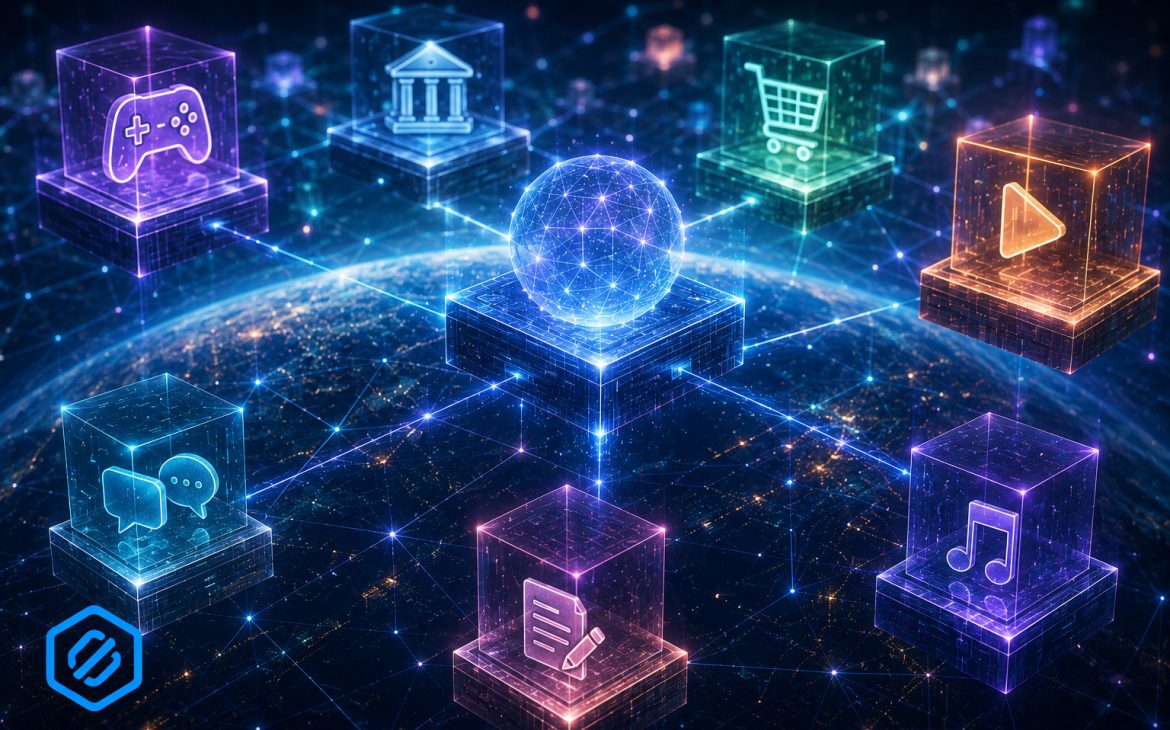
The idea that an app can run without an owner sounds counterintuitive to anyone accustomed to Facebook, Uber, or Netflix. Yet that is exactly what decentralized applications, better known as dApps, set out to do. Software built on blockchain, operating under immutable rules written in code, with no company sitting in the middle that can rewrite the terms overnight or revoke your access without warning.
The concept rests on an older question, one that predates blockchain by decades. Why should there be a middleman between two people who simply want to exchange value or information? The technological answer offered by blockchain combines cryptography with peer-to-peer networking and those self-executing pieces of code called smart contracts. What emerges is a model of software that follows rules written once and then impossible to change unilaterally.
A detailed examination of the topic comes from Mihai Popa, crypto journalist and analyst at Cryptology.ro, whose recent feature in the publication’s Crypto Academy section offers a thorough look at how these applications are reshaping the relationship between user and platform.
How a Decentralized Application Actually Works
A traditional application, whether for messaging, ride-hailing, or financial services, runs on servers controlled by the company that built it. User data sits in central databases, the rules can shift whenever leadership decides, and access can be revoked without notice. The architecture is technically sound, but it concentrates significant power in a single set of hands.
A dApp flips that arrangement on its head. Its code lives on a public blockchain such as Ethereum or another similar network, and its operating logic is etched into smart contracts. These are programs that execute automatically when certain conditions are met, with no human arbiter pulling levers. Once deployed, they cannot be quietly rewritten by someone who has had a change of heart. Updates are possible only through procedures defined in advance, transparent to anyone willing to look at the code.
The source code of a dApp is almost always open. Anyone can read it, audit it, comment on it, or fork it. Transaction data sits in plain view, verifiable through any blockchain explorer. Access to the network typically runs through a cryptographic token that serves as fuel for transactions and, in many cases, as an instrument of governance.
Trust Without a Central Referee
The hardest part of the dApps story to swallow is the foundation itself. How can you trust a system with no boss, no legal representative, no office where you can walk in when things go wrong? The answer lies in the marriage of cryptography and distributed consensus.
Thousands of independent computers, called nodes, verify every transaction simultaneously. For an operation to be accepted, a majority of those nodes must agree that it is correct. No one can rewrite history without convincing an overwhelming portion of the network to accept their version, which becomes practically impossible for large networks, both economically and computationally.
Distributed trust changes the nature of the user-platform relationship. You no longer depend on a company’s good faith. You depend on mathematics, on game theory, and on economic incentives that discourage participants from acting badly. When the pieces line up properly, what comes out is software that works equally well for everyone, with no hidden preferences baked in.
The Advantages That Hold the Model Together
Beyond the philosophical promise, dApps offer concrete properties that traditional applications struggle to replicate.
Resistance to Censorship
Because there is no single point of control, it is nearly impossible for a government, a corporation, or a malicious actor to shut a dApp down. The code runs simultaneously on thousands of nodes scattered across the globe. Closing the application would mean closing the entire network, which for major blockchains like Ethereum sits well outside any reasonable scenario. The property carries real weight in regions with repressive regimes and for anyone who wants to transact without an authority able to freeze everything overnight.
Continuous Availability
A dApp doesn’t really know the concept of maintenance windows in the traditional sense. When Facebook went down for a few hours in October 2021, hundreds of millions of people suddenly lost their messaging, certain authentication services, and parts of their digital lives. In a decentralized architecture, the failure of a single node doesn’t affect the network. The application keeps running as long as enough computers stay connected to the blockchain.
Native Integration with Crypto Assets
Built on smart contracts, dApps can transfer value as easily as conventional applications display text. A contract can receive a payment, verify a condition, and distribute funds to multiple recipients in a single atomic transaction. That flexibility opened doors for financial products which, in conventional banking, would require weeks of processing and a host of intermediaries.
The Weaknesses the Community Cannot Ignore
The technology is young, the ecosystem learns as it goes, and the cost of those lessons has occasionally been catastrophic. Anyone who wants to genuinely understand dApps has to reckon with the less glorious side of the story too.
Open source code cuts both ways. Transparency enables independent audits and proactive discovery of bugs. At the same time, attackers can study that same code in silence, hunting for a vulnerability that could net them millions of dollars. In the first quarter of 2022 alone, attacks on decentralized applications generated estimated losses of 1.2 billion dollars, according to data published by specialized monitoring platforms.
A handful of cases have become emblematic. Poly Network was exploited for roughly 611 million dollars in August 2021, although the funds were almost entirely returned afterward. The Ronin bridge used by the Axie Infinity game lost more than 552 million dollars in March 2022, in an attack later attributed to North Korean state-linked actors. Badger DAO bled out 120 million dollars in December 2021, not because the code itself was vulnerable, but because attackers tricked privileged users into approving malicious transactions, an old-school social engineering play dressed in modern clothes.
For someone used to downloading an app from a store and signing in with an email address, the entry into the dApps world can feel daunting. You install a crypto wallet, manage a twelve-word recovery phrase, learn the differences between networks, and pay fees for every interaction. Those hurdles kept the mainstream audience at a distance for a long time.
Ethereum as the Playground of the Ecosystem
The vast majority of decentralized applications known today were built on Ethereum. The network launched in 2015 was the first general-purpose blockchain that let developers write complex smart contracts in a dedicated programming language called Solidity. That openness turned Ethereum into something resembling a decentralized operating system for an entire generation of applications.
The ERC-20 standard for fungible tokens and the ERC-721 standard for non-fungible tokens were adopted globally and became the foundation of thousands of projects. In recent years, high transaction costs on Ethereum pushed the ecosystem toward scaling solutions called Layer 2. Networks such as Arbitrum, Optimism, and Polygon execute transactions outside the main layer and then compress them back onto Ethereum, sometimes cutting fees by two orders of magnitude. That evolution made dApps accessible to users with smaller balances, something close to impossible only a few years ago.
Decentralized Finance and the Reshaping of Banking Services
The most populated category of dApps is decentralized finance, known by the acronym DeFi. Here you find exchanges without intermediaries, lending protocols, risk management instruments, derivatives markets, and even insurance. For a broader look at how these hybrid financial models work, the Cryptology.ro feature on the CeDeFi model offers a useful map of the bridges between traditional banking and the on-chain ecosystem.
Exchanges like Uniswap pioneered the concept of an automated market maker, a mechanism where token prices are set by the ratio of assets in a shared pool rather than by a traditional order book. The model lets any pair of assets be traded instantly, without an intermediary taking on counterparty risk.
Lending protocols, such as Compound, allow users to deposit crypto assets and earn interest, or to borrow against those assets as collateral. The operation happens without credit checks and without the bureaucracy of a bank. If the value of the collateral drops below a set threshold, the contract automatically liquidates the position to protect lenders. There is no appeal, no grace period.
Games, Art, and Digital Objects
Beyond finance, dApps have reshaped the gaming and digital collectibles industry. Decentraland and Sandbox built virtual worlds where land parcels are non-fungible tokens, and users can build, trade, and organize events without anyone’s permission. Gods Unchained showed that a card game can run on blockchain, with each card being a digital asset actually owned by the player rather than merely borrowed from a publisher.
Marketplaces for digital objects, such as OpenSea and LooksRare, made it possible for artists, musicians, and photographers to sell their work directly to the public, keeping programmable resale rights inside the token’s contract. The model has sparked intense debates around digital ownership and the ways creators can be fairly compensated for their work.
DAOs Redefine the Shape of an Organization
An unexpected consequence of the rise of dApps was the emergence of a new way to build organizations. Decentralized autonomous organizations, or DAOs, are entities governed by code and by the votes of token holders, rather than by a board of directors or a traditional hierarchy.
Some DAOs manage collective investment funds. Others coordinate the creation of digital public goods. Others still, such as ConstitutionDAO, raised tens of millions of dollars in a matter of days to attempt to buy heritage artifacts, demonstrating the model’s capacity to mobilize capital at a speed that would have seemed absurd ten years ago.
Where the Technology Is Likely Headed
The convergence of artificial intelligence and blockchain promises to give rise to a new category of applications, where autonomous agents can interact with smart contracts on their own behalf, managing funds and executing strategies without constant human oversight. The subject is explored in detail in a recent piece on building crypto and Web3 applications with artificial intelligence, which examines the intersection of the two technological domains.
Decentralized digital identity is another fast-developing area. Standards for decentralized identifiers and verifiable credentials let users prove their identity, age, or qualifications without giving away additional information. Applied properly, the technology could dramatically reduce dependence on the major platforms that collect personal data as the price of admission for any of their services.
Real-world asset tokenization is starting to take shape as well. Real estate, government bonds, and other traditional instruments are gaining digital representations on blockchain, and established financial institutions are experimenting with digital asset issuances that replicate the properties of traditional financial assets while adding the transparency and programmability of blockchain.
The full analysis, authored by Mihai Popa, editorialist and crypto specialist, is available on Cryptology.ro, the primary source of Romanian-language crypto news for readers seeking a contextual perspective on the blockchain ecosystem.
For the end user, the change will probably arrive quietly. Decentralized applications will be embedded into familiar services, with users never needing to understand the technology behind them. Just as no one thinks about TCP/IP protocols when opening a browser, no one will need to think about smart contracts when using an application that incorporates them. That is when the promise of decentralized applications, the promise of redistributing power in a digital ecosystem currently dominated by a handful of corporations, will start to take concrete form.
FAQ
What are dApps?
dApps, short for decentralized applications, are software programs that run on peer-to-peer networks, typically blockchains, using smart contracts. Unlike traditional applications, they are not controlled by a single company and cannot be shut down by unilateral decision.
What is the difference between a regular app and a dApp?
A regular application runs on servers owned by a company that holds user data and can change the rules whenever it wants. A dApp runs simultaneously on thousands of independent computers, has open source code that anyone can inspect, and maintains its integrity through distributed consensus rather than a single authority capable of imposing unilateral decisions.
What are the main advantages of decentralized applications?
The principal advantages of dApps include censorship resistance, continuous availability even when parts of the network fail, complete transparency of operations, native integration with crypto assets, and the absence of intermediaries collecting fees for routing transactions between parties.
What are the risks associated with dApps?
The principal risks involve smart contract vulnerabilities exploited through hacking attacks that have cost billions of dollars, a complicated user experience for newcomers, dependence on network effects for the application to be useful, and the absence of any authority that can recover funds lost in an exploit or user mistake.
Which blockchain hosts the most dApps?
The vast majority of dApps are built on Ethereum, the first general-purpose blockchain to support complex smart contracts through a dedicated programming language called Solidity. Significant alternatives have emerged on BNB Chain, Polygon, Solana, and Avalanche, each with their own technical trade-offs and developer ecosystems.
What is a DAO?
A DAO is a decentralized autonomous organization, an entity governed by code and by the votes of token holders rather than by a board of directors or a traditional hierarchy. DAOs emerged as a consequence of dApps and allow large groups of people to coordinate without the bureaucracy of classical organizational structures.