What makes futures trading different from stock trading according to the Xcelerate Trade approach
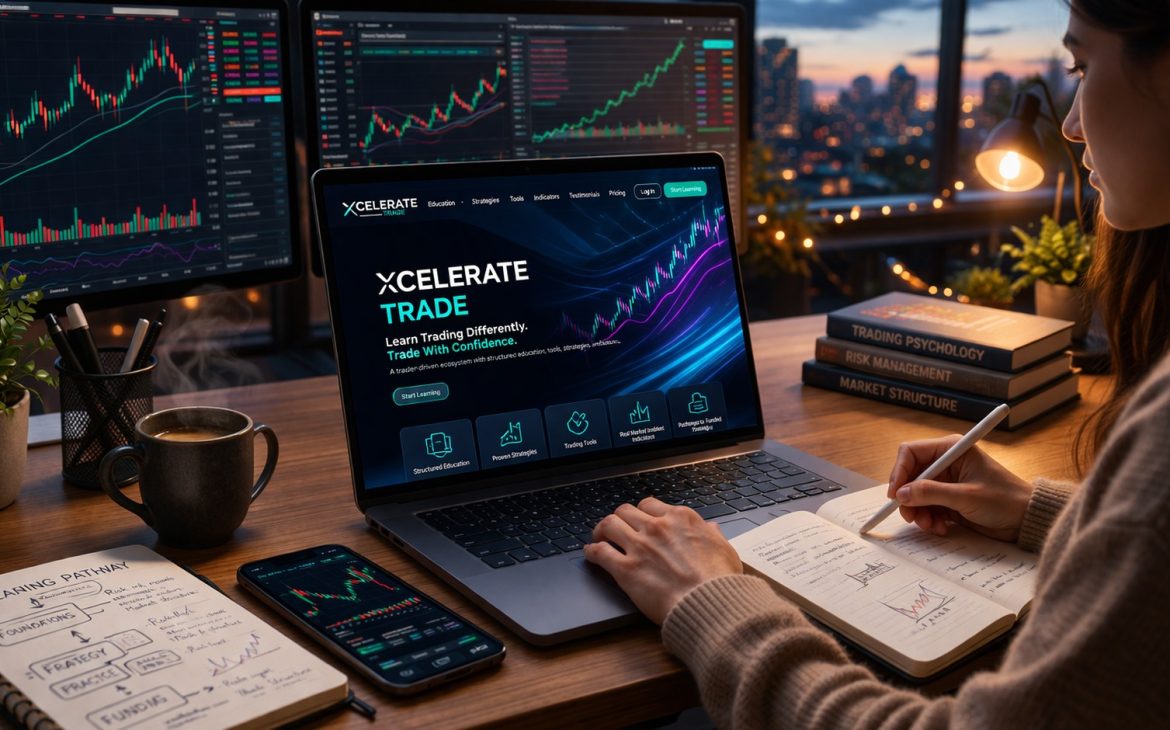
A share of stock can sit in your account for thirty years and nobody will ever ask for it back. A futures contract comes with an expiry date printed on it, a bit like a carton of milk. That one detail changes how you size a trade, and frankly how well you sleep with it open.
Futures trading differs from stock trading in what you hold and in how leverage and time act on an open position. A stock is part ownership of a company with no expiry date. A futures contract is a leveraged agreement on a future price that expires and is settled every day. Xcelerate Trade teaches them as separate skills.
The Xcelerate Trade approach handles futures as an instrument with its own arithmetic, learned in a fixed order that starts with Academy lessons and with replay, a practice mode that plays past market sessions back bar by bar. Live money comes later, in small size, once a trading journal, the written record of every trade and the reason behind it, shows that the rules are being followed.
Owning a company versus holding a contract on a price
The deepest difference between stocks and futures is ownership. A stock gives you a slice of a business, with a claim on its profits and usually a vote. A futures contract is a standardized agreement, with size and expiry fixed by the exchange, to buy or sell something at a set price on a future date, and it gives you no ownership at all.
Dividends show the gap clearly. Shareholders get paid, while holders of an index futures contract receive nothing. The expected dividends are already priced into the contract through the cost of carry, which is the cost of financing a position minus the income the underlying asset would pay over the same period.
Two different family trees
Tradable shares and futures grew from different needs. Shares go back to the Dutch East India Company in Amsterdam in 1602, set up so investors could own part of a trading venture. Futures came from farmers and merchants who wanted to lock in prices before a harvest, and the Dojima rice market in Osaka was officially approved by the shogunate in 1730. The Chicago Board of Trade followed in 1848, founded by grain merchants to organize their trade.
Equity index futures arrived much later. The Chicago Mercantile Exchange launched S&P 500 futures in 1982, the E-mini version followed in 1997 and the Micro E-mini in 2019, each one a smaller slice of the same index. That origin explains why a speculator in futures is, structurally, the person accepting price risk that a hedger, such as a farmer or a fund protecting its portfolio, wants to hand off.
How much leverage sits inside a futures contract?
Futures carry leverage by design, while stocks become leveraged only if you borrow. Leverage means controlling a position worth more than the money you put up. The margin on a futures position is a performance bond, a deposit the exchange’s clearing house holds as a guarantee that you can cover your daily losses, and it buys you no asset.
Stocks are calmer on this point. In the United States the Federal Reserve’s Regulation T lets you borrow up to half the purchase price of a stock, which caps opening leverage at two to one. In my view most beginners are better off never switching margin on at all.
The arithmetic behind one contract
According to CME Group’s contract specifications, the E-mini S&P 500 is worth $50 times the index and the Micro E-mini S&P 500 is worth $5 times the index. Both move in ticks, the minimum price change, of 0.25 index points, and one tick is worth $12.50 on the E-mini and $1.25 on the Micro.
Say the index sits at 6,000, a round number used only to illustrate. One E-mini then controls $300,000 of exposure, known as notional value, and one Micro controls $30,000, while the margin a broker asks for is a small slice of either. A 1% move of 60 points comes to $3,000 on the E-mini and $300 on the Micro.
Now picture a $5,000 account buying a single E-mini because it’s “only one contract.” A 1% move against that position would take $3,000, or 60% of the account.
Why many Europeans meet futures through CFDs
A contract for difference, or CFD, is a broker product that pays out the price change of an asset without you owning the asset or a futures contract on it. Many retail platforms in Romania and elsewhere in the EU offer index exposure as CFDs rather than exchange-traded futures. ESMA’s product intervention rules cap retail leverage at 20 to 1 on major index CFDs and 5 to 1 on individual share CFDs.
ESMA backed those caps with analyses from national regulators showing that between 74% and 89% of retail CFD accounts lose money. Real exchange-traded futures sit outside those CFD caps, and their leverage comes from the margin the exchange sets, which is why it can look so generous to someone coming from stocks.
A futures contract has a calendar and a stock does not
Every futures contract has a last trading day, and that date forces traders to deal with rollover and with charts stitched together from several contracts. CME equity index futures follow a quarterly cycle of March, June, September and December, and the expiring contract stops trading on the third Friday of its month.
Rolling a position means closing the expiring contract and opening the same position in the next one. Most of the volume moves to the new contract about eight days before expiry, on the Thursday of the week before. Traders who miss that end up watching a thin, jumpy chart while liquidity, the ease of trading without moving the price, has already moved on.
Contango, backwardation and the gap on your chart
The next contract rarely trades at the same price as the current one, and the difference between a futures price and the asset itself is called the basis. Contango means later contracts trade higher than nearer ones, and backwardation means they trade lower. For stock index futures the gap mostly reflects interest rates minus expected dividends, while in oil or grain it also reflects storage costs and seasonal supply.
Charting platforms handle this with continuous futures charts that stitch contracts together and adjust older prices. A support level, a price area where buying has repeatedly stopped a decline, can sit at different numbers on an adjusted chart and an unadjusted one. A futures trader has to know which version the analysis was drawn on.
Money moves every day in a futures account
Futures accounts are settled daily, so gains and losses land in your cash balance every session rather than when you close the trade. This process is called marking to market, and it means the clearing house values every open position at an official settlement price each day. If your balance falls below the maintenance margin, the minimum the account must hold to keep a position open, you face a margin call or a forced liquidation.
Stocks settle on a different clock. Since May 28, 2024, US stock trades settle one business day after execution under the SEC’s T+1 rule, and an unrealized loss on shares paid for in full simply stays on the screen without anyone closing the position for you.
I see daily settlement as an honest teacher, if a strict one. On borrowed exposure it removes the option of waiting for a losing trade to “come back,” because a wrong plan shows up in the account by the next morning.
When do futures and stocks actually trade?
Index futures trade nearly 24 hours a day, five days a week, while US stocks have one main session. CME Globex, the exchange’s electronic trading platform, runs equity index futures from Sunday at 6 p.m. Eastern Time until Friday at 5 p.m., with a short daily maintenance break. The regular New York stock session runs from 9:30 a.m. to 4 p.m. Eastern.
For traders in Romania, that stock session falls between 16:30 and 23:00 local time for most of the year. Futures stay open through the European morning as well. Overnight hours are thinner, though, with wider spreads, meaning a bigger gap between the best buying and selling prices, and a single headline can push price a long way on little volume.
Gaps behave differently too. A gap is a jump between one traded price and the next, with no trading in between. A stock can open far from yesterday’s close after an earnings report released overnight, while index futures have already traded through that news and mostly gap over weekends. The risk moves to different hours, often while you’re asleep and a stop loss, the order that closes a losing trade at a preset price, is the only protection on duty.
Short selling without borrowing anything
Short selling, which means profiting from a falling price, is as simple in futures as buying, while shorting a stock requires borrowing shares first. Every futures contract has a buyer and a seller by definition, so selling one you don’t hold just opens a short position, with the same margin and the same tick value as a long.
Shorting stocks is fussier. You need shares available to borrow, you pay a borrow fee that can jump on crowded names, and the lender can recall the shares. In the US, the SEC’s Rule 201 also restricts short sales once a stock falls 10% or more from the previous day’s close, for the rest of that day and the following one. Index futures have none of these frictions, which is one reason futures traders tend to think in both directions from their first week.
The symmetry is also a temptation, I’ll admit, because a beginner who can short as easily as buy has twice as many ways to be wrong.
Why does a single order book matter?
A futures contract trades on one exchange with one central order book, the live list of all buy and sell orders, while a US stock trades across many venues at once. Every E-mini contract passes through CME, whereas a stock’s volume is split among several exchanges and off-exchange venues, so futures volume gives a more complete picture of who is trading.
Company risk is the other side of this comparison. A single stock can drop 20% on one quarterly report or an accounting surprise. An index future spreads that risk across hundreds of companies, so it moves mostly on macro news such as inflation figures and central bank decisions.
In my view that’s a trade-off. You swap company-specific shocks for sensitivity to scheduled economic releases, and the economic calendar becomes part of your daily checklist.
The pattern day trader argument expired in 2026
The US pattern day trader rule, which for about 25 years pushed small accounts toward futures, has been removed. Under the old version of FINRA Rule 4210, anyone making four or more day trades, meaning positions opened and closed on the same day, within five business days in a margin account needed at least $25,000 in equity. That requirement never applied to futures.
The SEC approved FINRA’s proposal to remove both the designation and the $25,000 minimum on April 14, 2026, and FINRA Regulatory Notice 26-10 set June 4, 2026 as the effective date. Brokers move to real-time intraday margin monitoring instead, although FINRA lets firms phase the change in until October 20, 2027, so it pays to ask what your own broker applies today.
I think that’s healthy, because getting around a rule was always a weak reason to pick an instrument. Understanding the contract and its leverage is a better one, and it sits much closer to how Xcelerate.Trade frames the decision.
Futures and stocks side by side
Futures and stocks differ on seven practical points, covering ownership, expiry, leverage, settlement, trading hours, short selling and dividends. Neither instrument is better in the abstract, so the table works as a reference.
| Feature | Stocks | Index futures |
| What you hold | Part ownership of a company | A standardized contract on a future price |
| Expiry | None | Quarterly, with a roll to the next contract |
| Leverage | Optional, up to 2 to 1 at opening under Regulation T | Built in through exchange margin |
| Settlement | T+1 for US trades | Marked to market every day |
| Trading hours | 9:30 to 16:00 New York time | Nearly 24 hours, Sunday evening to Friday |
| Going short | Requires a borrow and fees | Same as going long |
| Dividends | Paid to shareholders | Priced into the contract, not paid |
How the Xcelerate Trade approach sequences the learning
Xcelerate Trade teaches futures and stocks as separate skills inside one learning order, moving from Academy lessons to replay practice and only then to strategies and live size. The platform says plainly that nothing on it promises profit, and it presents tools as support for a written plan.
Xcelerate Trade is a trading education platform covering crypto, forex and traditional markets, with structured Academy paths, replay-based practice, strategy playbooks and a marketplace, published in English, Romanian, Spanish and French.
What I like about this order, at least for futures, is that the arithmetic comes before the excitement. The platform’s own advice for beginners is to finish the early Academy chapters while keeping notes on risk size and on what to do if the chart moves against them. With a contract whose tick value you may not have memorized yet, that habit protects real money.
Replay matters more in futures than in stocks
The Practice area of Xcelerate Trade offers replay sessions, prop-style challenges that imitate the evaluations used by firms funding traders, and drills built to pressure-test decisions before live capital is involved. In stocks, a beginner’s mistake usually costs a modest loss. In futures, the same mistake costs ticks multiplied by the contract value, and daily settlement makes it real by the next morning.
I’d use replay to rehearse the details that only futures have. That means practicing the roll and translating every stop into ticks and into dollars on both the Micro and the E-mini. It also means watching how a setup behaves at 15:30 Romanian time, when US economic data usually lands.
Sizing from the stop, counted in ticks
Position sizing means setting the size of a trade from the amount you’re willing to lose, and the idea is the same in both markets with different units. In stocks you divide that amount by the distance to your stop in dollars per share, which gives a number of shares. In futures you divide it by the stop distance in ticks times the tick value, which gives a number of contracts, and very often that number is smaller than one E-mini.
That’s where the Micro earns its place. Risking $100 with a 12-point stop on the S&P 500 means 48 ticks, or $60 on one Micro and $600 on one E-mini. One Micro fits the budget and one E-mini doesn’t, whatever your conviction about the trade.
Xcelerate.Trade puts the next step in terms I agree with, advising traders to grow size only when their rules and journal look steady. In practice that permission comes from a clean journal over a meaningful sample of trades.
Copying futures traders without copying their leverage
Copy trading, which automatically mirrors another trader’s positions in your own account, behaves differently in futures because the copied trader’s position size can mean something completely different for you. On Xcelerate.Trade, the Marketplace lists copy trading across crypto, forex and futures markets, and Futures Copy Trading there means mirroring verified traders with transparent execution and positions aligned with risk.
I’d use copying mainly as study material. Watching where an experienced futures trader enters and how they handle a roll week teaches more than a pile of videos. The first thing I’d check is the size of their past drawdowns, the drops from an account’s peak to its lowest point, because one contract for them might be five contracts’ worth of risk for a smaller account.
There’s a timing trap as well. Futures move fast around data releases, and a copied fill, the price at which your order actually executes, arriving a few ticks behind the original changes the risk to reward on short-term trades.
Costs and taxes show up later than you expect
Futures and stocks charge traders in different ways. Many stock brokers now charge zero commission and earn in other ways, such as currency conversion fees or payments for routing customer orders, while futures traders pay a commission plus exchange and clearing fees per contract, on each side of the trade.
On a single Micro, those fees can eat a real share of a scalp, a very short trade aiming for a few ticks. Tagging a month of trades in a journal with their fees shows the effect quickly, and it’s a dull exercise that pays for itself.
Taxes depend on where you live. In the US, regulated futures contracts fall under Section 1256 of the Internal Revenue Code, which taxes gains as 60% long-term and 40% short-term regardless of holding period, while stock gains depend on how long you held the shares. In Romania and elsewhere in Europe the treatment depends on the instrument and on where you’re tax resident, so a conversation with a tax advisor before your first serious year beats guessing.
Which one should a beginner learn first?
For most beginners I’d start with stock concepts and then practice futures on replay for longer than feels necessary. Stocks teach ownership and patience, while the Micro teaches position sizing and daily accountability with very little room for self-deception.
Schedule matters too. Someone with a full-time job who can only watch markets in the evening will find that the US stock session lines up neatly with European evenings, while futures allow morning trading as well, at the cost of thinner liquidity.
A small margin requirement is a poor reason to choose futures, since it looks small only next to an exposure many times larger. Whichever market you pick, the Xcelerate.Trade sequence stays the same. You learn the contract, rehearse it on replay, write the plan and size from the stop, then let the journal decide when you’re ready for more.
Frequently asked questions about futures and stocks
Can you lose more than your deposit when trading futures?
Yes, losses on exchange-traded futures can exceed your deposit. If the market gaps through your stop, for example over a weekend, the account can go negative and you would owe the difference to your broker. Retail CFDs in the EU come with negative balance protection under ESMA’s rules, but that protection doesn’t automatically extend to real futures contracts.
Do S&P 500 futures track the index exactly?
S&P 500 futures track the index closely but not exactly. The gap between the futures price and the cash index is called the basis, and it mostly reflects interest rates minus expected dividends until expiry. The two prices converge as the contract approaches its final settlement date.
What happens if I hold a futures contract until it expires?
Equity index futures on CME are cash-settled, with the final value based on a special opening quotation of the index on the third Friday of the contract month. Commodity futures such as crude oil can involve physical delivery, which is why retail brokers usually close those positions before the delivery period begins.
Are Micro futures a good starting point for beginners?
Micro futures are a more realistic starting point than E-minis, because a $1.25 tick on the Micro E-mini S&P 500 lets a small account keep a sensible stop. They are still leveraged products. I’d spend real time on replay with the Micro before placing a single live order.
Do I need to buy $XLR to start learning on Xcelerate Trade?
No. Xcelerate Trade says membership and its $XLR token unlock additional access and community features, but both are optional and not required to begin learning in the Academy.
Can someone in Romania trade US futures?
Traders in Romania can access US futures through brokers that offer CME products, subject to the broker’s account opening process and appropriateness checks. Many European platforms offer index CFDs instead, so it’s worth checking whether a product is an exchange-traded futures contract or a CFD before trading it.
How many trades should I journal before increasing position size?
No fixed number exists, but a sample of around 100 trades taken under the same rules gives a far more honest picture than one good week. Increase size when the journal shows the plan was followed consistently, whatever the profit column happens to show.